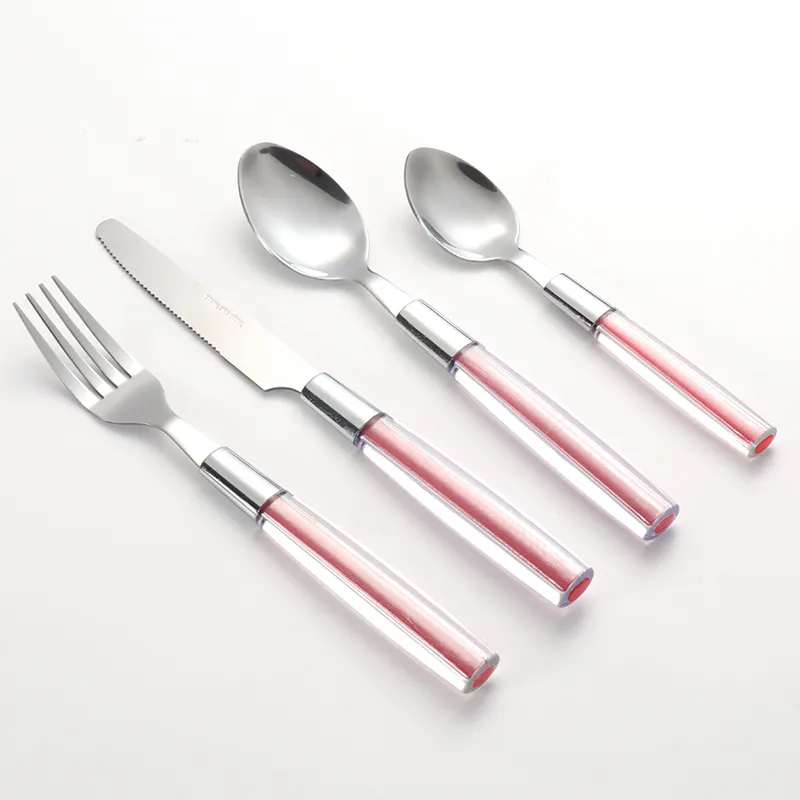
European boutique restaurants are reshaping table aesthetics with “light luxury metal style”. PVD gold/champagne stainless steel flatware, with stable color, dishwasher resistance, and food safety, has become standard for Nordic minimalist, French retro, and Italian casual styles, replacing traditional electroplating. This article focuses on 4 core points for production and export reference.
Application & Popularity Analysis

Style & Color Preference
| Style | Color | Matching | Adaptation Logic |
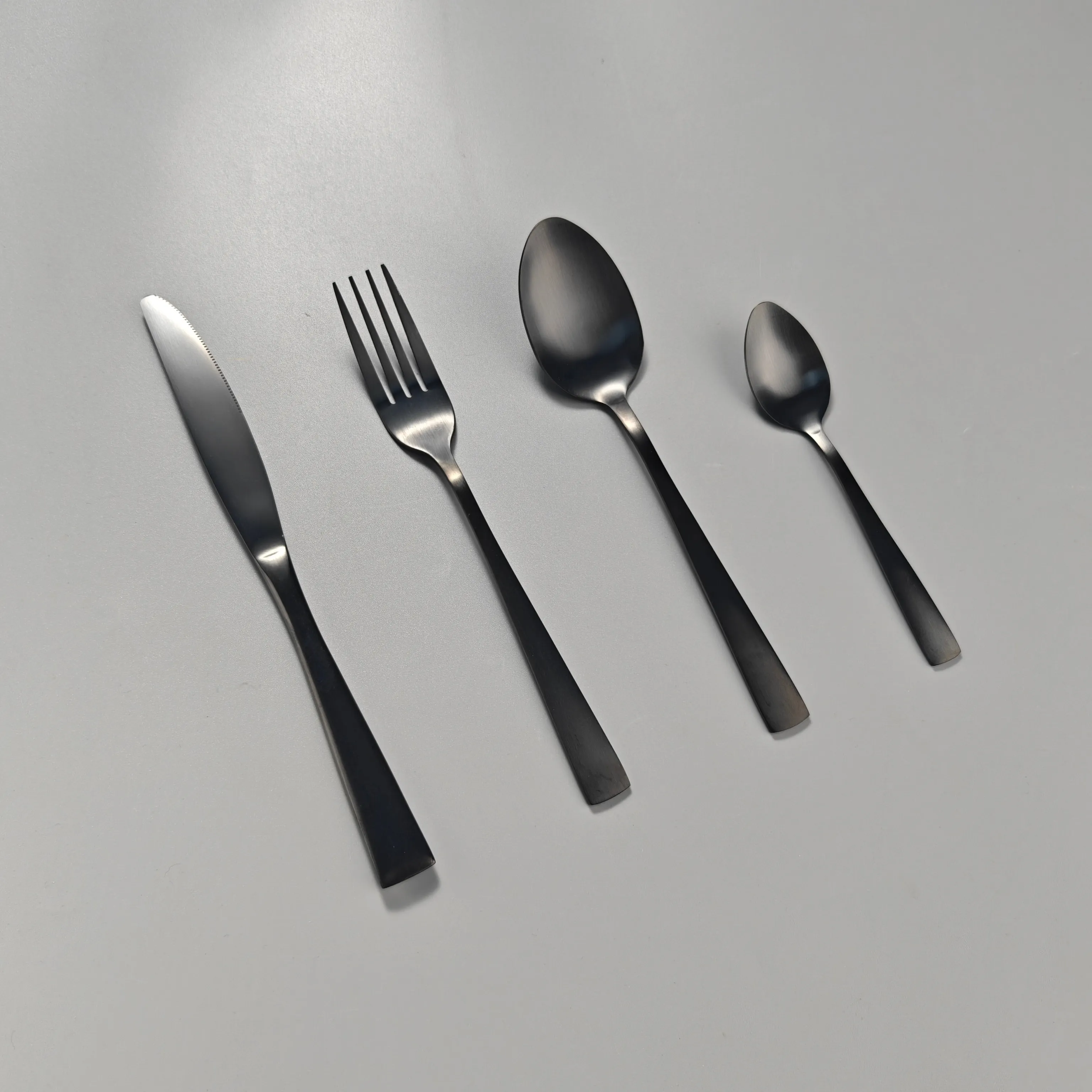
| Nordic Minimalism | Matte Champagne | Light wood, white | Warm and minimalist, weakening metallic feeling |
| French Retro | Mirror Gold | Cream, brass | Enhance ritual sense, echo court aesthetics |
| Italian Casual | Semi-matte Champagne | Clay, olive tones | Oil-resistant, fit Mediterranean dining |
| Industrial Style | Matte Gold | Exquisite contrast, improves space hierarchy | Exquisite contrast, improve space hierarchy |
Popularity Drivers
- Dishwasher Compatibility: Withstand ≥120 cycles (80–85℃), no peeling/discoloration, solving the electroplating fading issue.
- Cost-Aesthetics Balance: 1/3 cost of brass, with light luxury texture, meeting boutique restaurants’ needs.
- Consumption Upgrade: High-value flatware becomes a social media highlight, boosting popularity.
Process Analysis (PVD vs Electroplating)
PVD (Physical Vapor Deposition) and traditional electroplating differ significantly in bonding, performance, and environmental protection, determining market competitiveness.
| Dimension | PVD (Gold/Champagne) | Traditional Electroplating |
| Principle | Vacuum atomic deposition, metallurgical bonding | Aqueous electrolysis, physical adhesion |
| Component | TiN (gold), TiCN (champagne) | Potassium gold cyanide (toxic) |
| Hardness/Corrosion | HV≥1800, 168h salt spray no pitting | HV≤600, 24h salt spray rusting |
| EU Acceptance | High-end standard, green production | Gradually eliminated, import restricted |
Key Notes: PVD gold (TiN, 250–300℃, 2.0–3.0μm); Champagne (TiCN, 200℃, better acid resistance).
PVD Quality Judgment
The quality of PVD coating is mainly judged by dishwasher test, with the core standard that the coating does not peel off or fade within a certain cycle.
- Standard Grade: For products used in regular household scenarios, a coating technology of about 40 cycles is adopted.
- High-End/Commercial Grade: For high-end products or those with high cleaning frequency, 60 cycles or even 120 cycles of coating technology are used.
In addition to cycle resistance, a high-quality PVD coating should have no wrinkles, no damage and no obvious color difference on the surface. After the PVD process, a fine cleaning link must be added to ensure the surface luster of the flatware. For restaurant use, it is more practical to choose products with 60 cycles or more and adopt matte polishing technology, which makes the flatware more durable and maintains its texture.
As a professional flatware set source factory, Huashun can provide authoritative test reports issued by Intertek Lab (China) according to customer requirements.

EU Food Contact Compliance
European boutique restaurants require compliance reports, following EC 1935/2004, DGCCRF 2004-64 and Germany’s specific LGBF standard.
| Regulation | Requirement | Tests | Limit |
| EC 1935/2004 | No harmful substances | Heavy metal migration | Pb≤0.05, Cd≤0.01mg/dm² |
| DGCCRF 2004-64 | Metal coating control | Ni/Cr migration | Ni≤0.1, Cr(VI)≤0.002mg/dm² |
| Germany LGBF | Strict metal migration | Multi-metal migration, PAA test | Ba≤1.0, Cu≤5.0, PAA≤0.01mg/kg |
Our factory, Huashun, can provide reports: food metal contact reports, dishwasher test reports and LGBF compliance test reports in accordance with national standards.
Summary
PVD gold/champagne is the high-end standard for European boutique restaurants, with core advantages of high wear resistance, corrosion resistance and compliance. Focus on ≥2μm film thickness, 316L substrate, multi-arc plating, and strictly follow EC 1935/2004, DGCCRF 2004-64 and Germany LGBF standard to meet market demand, especially for the German market.